When it comes to evaluating the security of your retirement home, it is important to start at the perimeter and work your way in. This means that your security begins and ends with your gate lock. To help you appreciate the importance of having quality gate locks and latches, we reached out to experts at Locks & Handles. With years of experience in security hardware, including locks for gates, we were able to learn a lot about what makes a quality gate lock for a retirement home.
The people residing in your retirement home are here because they likely need assistance. That could mean help with their mobility and independence, but it could also relate to their security. As such, you want to have as much investment as possible in your security and especially your gate lock. The more intruders and trespassers you can keep out, the safer everyone in your retirement home will feel. So, where do you start?
Why A Gate Lock Should Be A Priority For Every Retirement Home
Retirement is supposed to be peaceful and calming, right? Anyone who reaches retirement age has the right to feel safe. That means that, as the individual in charge of your retirement home, you want to give people living here as much autonomy as possible, whilst keeping them safe. This means investing in a quality gate lock, whether it’s for the communal garden or, more likely, individual homes.
- Residents of retirement homes tend to be looking for high-quality, reliable safety
- At the same time, they wish to be able to operate their gate lock with relative ease
- This means using simplified access controls without compromising on security depth
- It might also mean investing in systems that are keyless to avoid key loss impacts
- At the same time, be mindful of how technologically comfortable residents are
Retirement facilities must have quality security systems in place that are still easy to operate. The challenge is that ease of operation for the owner also means ease of operation for trespassers. That then defeats the purpose of having a gate lock in the first place. An outdoor gate lock that can be undone simply by reaching over the gate, for example, is of no use!
Therefore, you need to take into account security quality and ease of access for residents and staff. Making sure that the gate can be easily operated without confusion is one thing; you also need to look into making sure the gate remains secure from the outside so that criminals cannot manipulate the gate. This is no easy task, but one that is worth investing considerable time and effort into.
Choosing Elderly-Friendly Gate Locks
There are some essential features that should be non-negotiable when choosing a potential gate lock for a retirement home. Locks & Handles staff recommended to us that you should consider:
Easy To Grip Gate Handles
First and foremost, the gate should be easy to open for older people. That means that the handle should have wide, easily managed grips. Ask your staff to try out any potential gate handles; are they able to open them with ease? If they struggle even slightly, it might be too much for your elderly retirees. You want to find a happy balance between ease of grip and strength.
Try to look for gate handles that are not too thick, either. Older adults tend to have smaller hands, so they can find it hard to get their hands around thicker, wider gate lock handles. The gate should have handles which are easily held onto and pulled to open the gate without needing major force.
Large Keyways
If you go for a gate lock with key access, then you need to make sure that the keyways are large. Retirees might have physical issues, or even issues with their eyes or hand-to-eye coordination. As such, they might find it hard to accurately line up smaller keys and smaller keyways. Instead, invest in a larger outdoor gate lock. They are much more likely to be able to line up the key without dropping the key or getting frustrated. Just be sure that if you go down the key route, there is a system in place for storing and keeping their keys in a safe place. Otherwise, you might need a locksmith to assist!
Smooth-Action Gate Locks & Latches
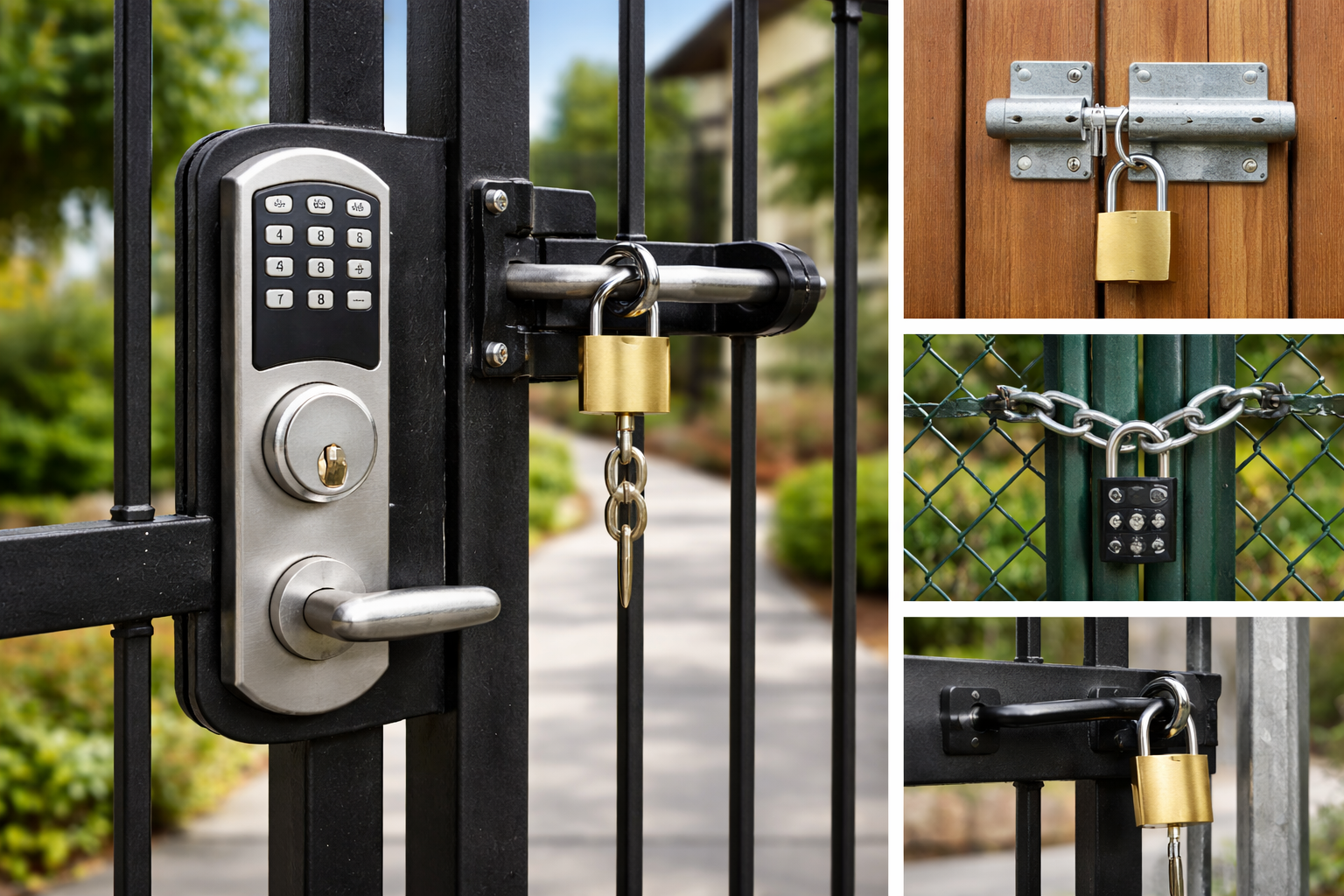
The last thing you want or need is a gate system that, when opened, causes your residents to lose their balance. Focus on installing gate locks and latches which have a smooth action. This includes thumb latch-operated models, as well as gravity and spring-loaded latch systems. Again, you need to ensure that they only require a level of pressure that your retirees are capable of providing.
Minimal force should be required to open the gate, as your focus should be on making sure that your retirees never feel trapped. You can still invest in quality locks that do not require major physical force to open, after all!
Digital Key Locks
Lastly, you might also wish to think about going down the digital route. Now, it should be noted that this might not be ideal for most retirees. Unless your residents agree to the installation, avoid going down this route. Some retirees will be tech-savvy enough to be able to operate a digital key system.
These provide the best-in-class security and solutions that a criminal will not be able to manipulate. They can also be easily operated by your staff by using access control credentials like a PIN code, biometric scan or similar. Again, not every elderly individual will enjoy going digital, so discuss this with your residents first. If they agree to it, though, going digital is often the way to go.
Gate Locks For Retirement Homes: Safe Living Is Possible
With the right gate lock, you can significantly reduce the physical strain on your residents. Not only that, but a quality, well-fitted gate lock will boost their sense of confidence in your security setup, all without compromising their ability to go about their day.
For a system that improves confidence in your retirees and gives staff easier access to the premises, all while reducing the risk of intruders, focus on buying a gate lock that matches the above requirements.