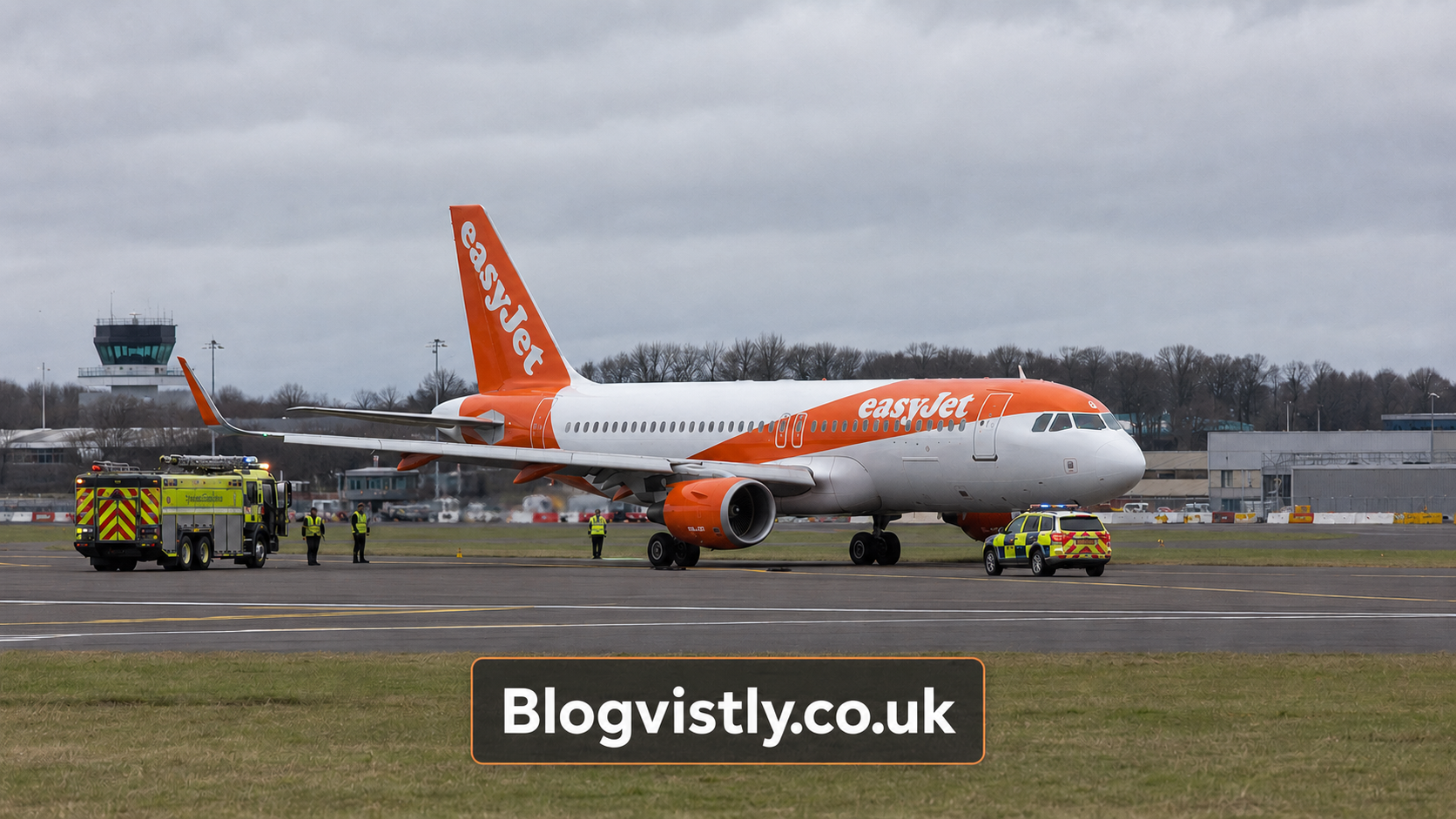
The EasyJet Flight U2238 emergency landing Newcastle story has attracted considerable online attention, with travellers searching for reliable information about the diversion, its cause, and the safety of those onboard. The incident occurred during an easyJet service travelling from Copenhagen to Manchester on the evening of October 27, 2025. While crossing the North Sea, the pilots changed course and landed at Newcastle International Airport after a passenger required urgent medical assistance.
Despite alarming descriptions circulating online, available reports do not suggest that the aircraft suffered an engine problem, fire, structural failure, or other major technical malfunction. The diversion was reportedly made because of a passenger welfare issue. The aircraft landed safely, medical personnel responded after arrival, and the remaining journey to Manchester was completed later that night.
Quick Facts About the Newcastle Diversion
| Detail | Reported information |
|---|---|
| Airline | easyJet |
| Correct commercial flight number | U22238 |
| Operational identifier | EZY2238 |
| Commonly searched number | U2238 |
| Original route | Copenhagen to Manchester |
| Date | October 27, 2025 |
| Aircraft type | Airbus A320 |
| Diversion airport | Newcastle International Airport |
| Reported reason | Passenger medical or welfare emergency |
| Landing outcome | Aircraft landed safely |
| Onward journey | Flight later continued to Manchester |
The most important correction concerns the flight number. Numerous articles describe the event as the EasyJet Flight U2238 emergency landing Newcastle, but the Copenhagen-to-Manchester service was reportedly U22238, displayed operationally as EZY2238. Flight-tracking records show that U2238 is also used for a Newcastle-to-Bristol service, which may explain why conflicting descriptions appear in search results.
What Happened on the easyJet Flight?
The easyJet Airbus A320 departed Copenhagen Airport for Manchester on October 27, 2025. The flight initially proceeded normally, climbing to cruising altitude and travelling west across the North Sea. During the journey, however, a passenger reportedly became seriously unwell and required medical attention that could not be fully provided while the aircraft remained in the air.
Cabin crew members are trained to respond to onboard medical incidents using first-aid equipment and procedures available on the aircraft. Once the pilots were informed that the passenger needed urgent professional care, they evaluated nearby airports and decided to divert. Newcastle International Airport was selected as a suitable location where the aircraft could land safely and emergency medical personnel could meet the flight.
Why Did the Aircraft Divert to Newcastle?
Pilots do not automatically continue to the scheduled destination when a passenger experiences a potentially serious medical problem. They assess the passenger’s condition, the aircraft’s position, nearby airports, weather conditions, runway suitability, available emergency services and the time required to reach professional medical care.
Newcastle was reportedly a practical diversion point because it was accessible from the aircraft’s position over the North Sea and could safely receive an Airbus A320. Continuing to Manchester might have kept the passenger in the air longer. By turning toward Newcastle, the crew could arrange a priority landing and transfer responsibility to ground-based medical professionals sooner.
Was It a Mechanical Emergency?
There is no reliable public report indicating that the diversion resulted from an aircraft malfunction. Reports consistently describe the reason as a passenger medical emergency or passenger welfare issue. No fire, engine failure, loss of cabin pressure, security threat or damage to the Airbus A320 was publicly identified in connection with the incident.
This distinction is important because the term “emergency landing” can create the impression that an aircraft was in immediate danger. In aviation, pilots may declare an emergency for several reasons, including a medical situation involving someone onboard. Declaring an emergency allows air traffic controllers and airport services to prioritise the flight, even when the aircraft itself remains fully operational.
What Does Squawk 7700 Mean?
Published accounts state that the aircraft transmitted squawk code 7700 during the diversion. Squawk 7700 is a general emergency code entered into an aircraft’s transponder. It alerts air traffic control that the flight requires priority handling and additional assistance.
The code does not identify the exact nature of the emergency. It may be used during technical problems, medical incidents or other urgent situations. In this case, reports connect its use with the need to get an unwell passenger to medical care. Air traffic controllers could then coordinate the aircraft’s approach while Newcastle Airport prepared the appropriate response on the ground.
The Safe Landing at Newcastle Airport
The Airbus A320 reportedly landed safely at Newcastle at approximately 10:52 p.m. GMT. Emergency personnel and paramedics were prepared to respond after the aircraft arrived. There were no reports of an abnormal touchdown, evacuation, runway accident or injuries caused by the landing itself.
Once the aircraft was parked, medical responders could access the passenger and provide a higher level of care than was available in the cabin. Some reports state that the passenger was subsequently taken to hospital, although detailed medical information was not released publicly. The absence of further information is understandable because airlines and hospitals generally protect patients’ privacy.
What Happened to the Other Passengers?
The diversion disrupted the journey but did not end the flight. Passengers had to remain in Newcastle while the medical response and necessary operational procedures were completed. Reports indicate that the aircraft was cleared to continue to Manchester after the affected passenger had been assisted.
The flight reportedly departed Newcastle shortly after midnight on October 28 and reached Manchester at approximately 12:28 a.m. This meant the other passengers completed their original journey after a delay rather than being stranded overnight or transferred to another aircraft.
Why Medical Diversions Are Taken Seriously
An aircraft cabin is a controlled but limited medical environment. Cabin crew may provide first aid, oxygen and support using onboard equipment, but they cannot reproduce the diagnostic tools, medications and specialist treatment available in a hospital. A condition that appears manageable initially can also deteriorate during the remaining flight.
The captain therefore has to balance operational considerations against the possible consequences of delaying medical care. A diversion can inconvenience hundreds of travellers and create additional costs for the airline, but passenger safety takes priority. The EasyJet Flight U2238 emergency landing Newcastle incident demonstrates how crews can use existing aviation procedures to shorten the time between an onboard emergency and professional treatment.
Was the Landing Dangerous?
Nothing in the available reporting indicates that the aircraft was in danger of crashing. The plane remained controllable, landed normally and later continued to Manchester. In this context, “emergency landing” means that the flight was given priority because an urgent situation existed onboard, not that the aircraft had lost the ability to fly safely.
For passengers, the sight of emergency vehicles or a sudden route change can understandably be frightening. However, having responders waiting at the airport is a precautionary part of emergency planning. It allows assistance to begin immediately and does not necessarily mean that the aircraft has suffered a serious mechanical failure.
U2238, U22238 or EZY2238: Understanding the Confusion
EasyJet uses U2 as its two-character airline code in passenger schedules. When this code is combined with the service number 2238, the complete commercial identifier becomes U22238. Aviation systems may instead use easyJet’s three-letter operational designator, EZY, producing EZY2238.
Many online posts appear to have shortened the number to U2238, creating confusion with a different easyJet service. Current flight-history listings associate U2238 with a Newcastle-to-Bristol route. Therefore, anyone researching the October 2025 Copenhagen-to-Manchester diversion should search for U22238 or EZY2238 when checking aviation records.
Could Passengers Receive Compensation?
A medical emergency involving another passenger is generally outside an airline’s direct control. Compensation rules for delayed flights depend on several factors, including the length of the delay, the journey involved and whether the disruption resulted from extraordinary circumstances.
Passengers may still be entitled to reasonable care during a significant disruption, even when fixed financial compensation is unavailable. However, eligibility must be assessed using the passenger’s booking details, actual arrival delay and the circumstances recorded by the airline. Travellers affected by the incident would need to contact easyJet directly and retain their boarding passes, receipts and travel documents.
Key Updates About the Incident
As of July 24, 2026, no verified public information appears to indicate that the diversion was connected to a technical defect or broader safety problem involving the aircraft. The available accounts continue to describe it as a medical diversion involving one passenger.
No confirmed public update about the passenger’s subsequent condition has been identified. This should not be interpreted as evidence of either recovery or deterioration. It simply means that detailed medical information was not released publicly. The aircraft’s safe onward journey to Manchester remains the clearest indication that the plane itself was not experiencing a reported technical emergency.
What the Incident Shows About Aviation Safety
Diversions are inconvenient, but they are also evidence that aviation safety procedures are functioning as intended. Cabin crew assessed and supported the passenger, pilots changed the route, air traffic control prioritised the aircraft, Newcastle Airport prepared its response, and medical professionals took over after landing.
The EasyJet Flight U2238 emergency landing Newcastle was therefore not a crash or reported mechanical failure. It was a controlled medical diversion in which the crew chose immediate passenger welfare over maintaining the original schedule.
Conclusion
The incident widely described as the EasyJet Flight U2238 emergency landing Newcastle involved an easyJet Airbus A320 travelling from Copenhagen to Manchester on October 27, 2025. A passenger reportedly became unwell during the flight, leading the pilots to divert to Newcastle International Airport for urgent medical assistance.
The aircraft landed safely, emergency responders assisted the passenger, and the flight later continued to Manchester. Available information does not identify a mechanical fault, fire or security threat. The correct commercial flight number appears to have been U22238, also shown operationally as EZY2238, while U2238 became the commonly searched but potentially misleading version of the number.