
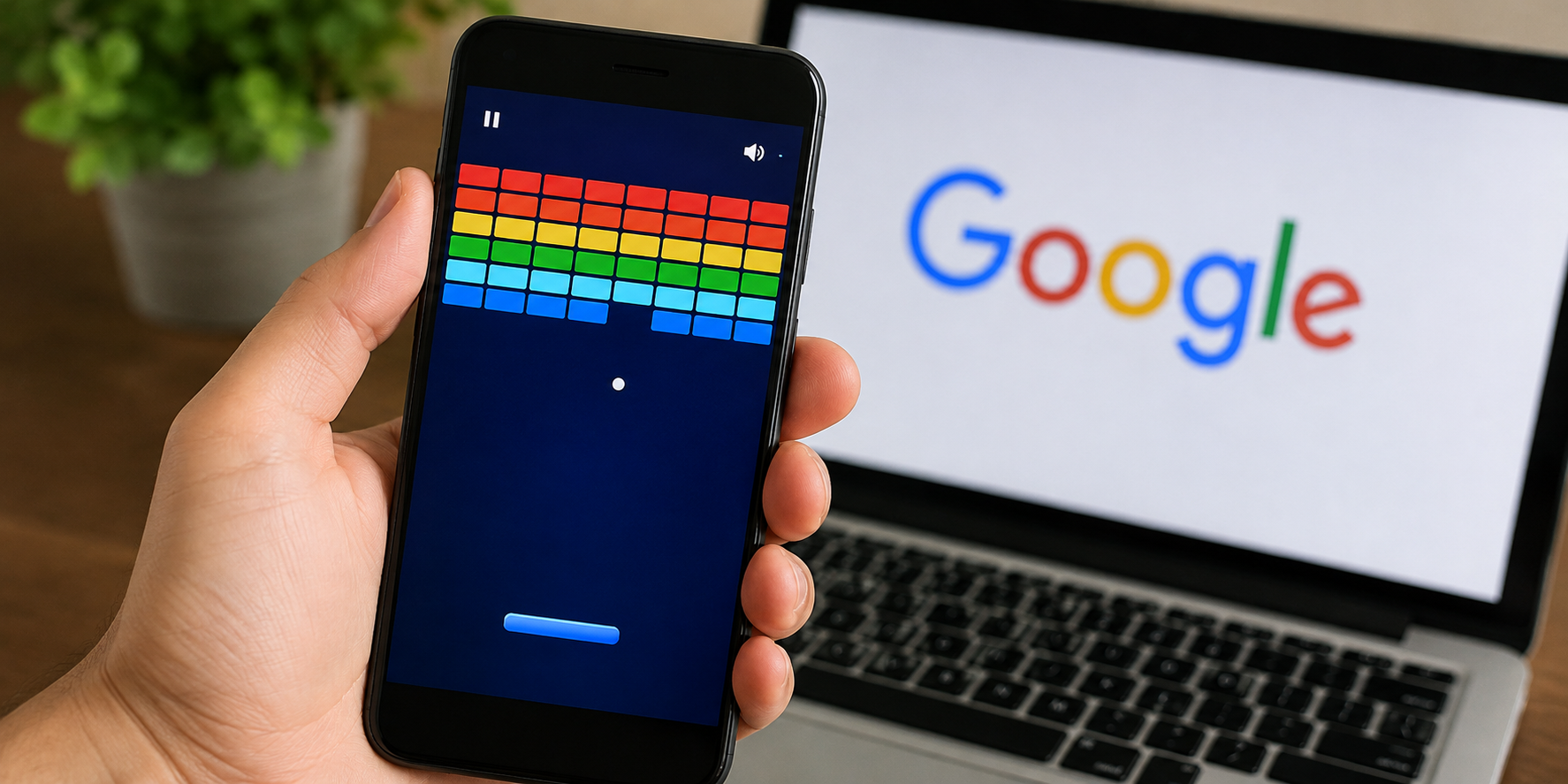
Google Block Breaker is a simple arcade-style game that brings the classic brick-breaking experience directly into the web browser. It follows a familiar formula: a paddle moves across the bottom of the play area, a ball bounces around the screen, and your goal is to destroy blocks while keeping the ball from falling past the paddle. The game is designed to be quick to understand, but improving your score requires timing, positioning, and a little strategy.
The game became available through Google Search in January 2025 and was reported by technology publications as another interactive experience added to Google’s collection of search-based games. Searching for terms such as “block breaker” can bring up the interactive game experience, depending on availability and region.
What Is Google Block Breaker?
Google Block Breaker is a browser-based brick-breaking game inspired by the classic Breakout-style arcade format. Instead of installing a separate application, players can access the game through Google Search when the interactive result is available. The basic objective is straightforward: use the paddle to bounce the ball into the blocks, destroy the blocks, and survive as long as possible.
The appeal comes from its simplicity. There are no complicated controls to learn, and a new player can understand the basic mechanics within seconds. At the same time, faster ball movement, changing angles, special blocks, and power-ups can make later gameplay considerably more challenging. Reports about the game also note that it includes functional upgrades and additional balls, giving it more depth than a basic Breakout clone.
How to Find Google Block Breaker
Finding Google Block Breaker is generally easy. Open Google Search in a supported web browser and search for “block breaker” or a closely related phrase. When the interactive game is available, Google can display the game directly within the search experience, allowing you to start playing without downloading a separate game application.
Availability can vary because Google occasionally changes or removes interactive Search features. If the game does not appear, checking your browser, trying another device, or searching again later may help. It is also important to distinguish the Google Search game from third-party websites that use the same or similar “Block Breaker” name.
How to Play Google Block Breaker
The main gameplay mechanic is easy to learn. A ball moves around the play area and bounces off the walls, paddle, and blocks. You control the paddle at the bottom and must position it so the ball hits the paddle instead of passing underneath it. Each successful hit keeps the rally alive and gives you another opportunity to break blocks.
On desktop devices, keyboard controls can be used to move the paddle. Current guides report left and right movement controls, while some versions also provide additional keyboard shortcuts for launching the ball or controlling other game functions. On touch devices, the controls may be adapted for mobile interaction. Because browser implementations can change, the exact controls may differ between versions or devices.
Understanding the Game Board
The board normally contains a group of colored blocks positioned above the paddle. The ball travels through this area, damaging or destroying blocks when it makes contact. Once enough blocks are removed, the game can progress to another stage or continue with a more demanding arrangement.
Not every block necessarily behaves in exactly the same way. Some versions and descriptions of Google Block Breaker identify marked blocks that can produce power-ups. These additions make the game more strategic because the player has to decide whether pursuing a particular target is worth changing the ball’s trajectory or paddle position.
Lives and Game Progress
One of the most important things for beginners to understand is that missing the ball has consequences. When the ball passes the paddle, you lose a life or one of the available attempts. Guides describing the current game commonly report three balls or lives at the beginning of a game.
This makes defensive play just as important as destroying blocks. A player who focuses only on hitting blocks can quickly lose control when the ball becomes faster. Instead, successful gameplay combines offense and defense: break blocks whenever possible, but always keep your attention on where the ball is going to land next.
Best Google Block Breaker Tips for Beginners
The first useful tip is to watch the ball rather than constantly looking at the blocks. Your paddle position determines whether the next bounce succeeds, so predicting the ball’s landing point is more important than simply moving toward the center of the screen.
Another helpful habit is to avoid unnecessary paddle movement. Beginners often move the paddle too aggressively and end up positioned incorrectly when the ball changes direction. Small, controlled adjustments are usually easier to manage. Once you become comfortable with the timing, you can deliberately use different parts of the paddle to influence the ball’s rebound angle.
Use the Paddle Angle to Your Advantage
Where the ball hits the paddle can affect its direction. A hit near the center tends to produce a different trajectory from a hit near one of the edges. This gives experienced players a way to influence where the ball travels rather than simply waiting for random rebounds.
Use this mechanic carefully. If the ball is moving quickly, attempting an aggressive angle can increase the chance of missing the next return. When your priority is survival, a predictable rebound may be better than a risky shot. When you have plenty of room and time, however, changing the angle can help direct the ball toward difficult areas of the block formation.
Target Openings and Weak Areas
When a ball reaches the upper part of the board, look for opportunities to create openings. Breaking blocks in useful locations can allow the ball to travel behind or through portions of the remaining formation, producing multiple hits without requiring you to aim every shot manually.
This is one of the biggest differences between simply playing and playing strategically. Instead of treating every block as an individual target, think about how removing one section can change the ball’s future path. Creating an opening can sometimes produce a chain of useful rebounds and clear several blocks more efficiently.
Make Power-Ups Work for You
Power-ups are among the features that make Google Block Breaker more interesting than a basic brick-breaking game. Certain marked blocks can release helpful upgrades when broken. Depending on the game version and the item involved, these upgrades can provide advantages such as additional balls or other temporary gameplay benefits.
The key is not to chase every power-up automatically. A falling item is useful only if you can safely collect it. Moving the paddle too far to catch a power-up can cause you to miss the ball, turning a potential advantage into a lost life. Always consider the ball’s current position before moving toward a falling bonus.
How to Improve Your Score
High scores generally come from consistency rather than one lucky shot. The longer you keep the ball in play and the more efficiently you clear blocks, the better your overall performance can become. Maintaining control becomes especially important as the game gets faster.
Try to develop a repeatable rhythm. Watch the ball, predict its landing point, move the paddle into position, and immediately return your attention to the ball. Avoid becoming distracted by the score counter or by blocks that are far away from the ball’s current path.
Common Mistakes to Avoid
One common mistake is staring at the blocks instead of tracking the ball. The blocks are your targets, but the ball is the immediate threat. If you lose sight of its trajectory, even for a moment, it can quickly reach the bottom of the screen.
Another mistake is making large movements when small adjustments would work. Overcorrecting can place the paddle too far from the ball. Players should also avoid sacrificing a life simply to collect a power-up. A bonus is valuable, but keeping the current ball alive is usually the more important objective.
Google Block Breaker on Mobile Devices
Google Block Breaker can be convenient for casual play because the experience is browser-based rather than requiring a traditional game installation. Mobile users may interact with the paddle through touch controls when the supported version provides them.
The exact mobile interface can change as Google modifies its Search experiences. If touch controls feel difficult, landscape orientation or a larger screen may provide better visibility and control. The most important factor is having enough space to clearly follow the ball’s movement.
Google Block Breaker vs. Classic Breakout
The basic concept behind Google Block Breaker is closely related to the classic Breakout family of games. Breakout was introduced by Atari in 1976 and established the familiar paddle, ball, and brick formula that influenced countless games afterward.
Google’s version uses that recognizable foundation but adds a modern browser-based presentation and additional gameplay elements. The result is deliberately simple enough for a quick session while still offering features such as power-ups and progressively challenging play. Google Block Breaker should therefore be viewed as a modern interpretation of a long-established arcade concept rather than an entirely new genre.
Why Google Block Breaker Is So Addictive
The game’s strongest feature is its accessibility. Players do not need to spend time learning a complex ruleset. The objective is immediately visible, the controls are simple, and each successful rally provides instant feedback.
There is also a natural desire to improve. After losing a game, players often know exactly what went wrong: a missed return, an overly aggressive movement, or a poorly timed attempt to collect a bonus. That makes another attempt feel worthwhile because the learning curve is short and progress can be measured through better survival and higher scores.
Strategies for Advanced Players
Once basic paddle control becomes comfortable, focus on predicting the ball’s path several moves ahead. Instead of reacting only when the ball approaches the paddle, watch its movement after each wall or block collision. This gives you more time to position yourself.
Advanced players should also think about risk management. Sometimes the fastest route to clearing blocks is not the safest route to a high score. If the ball is moving unpredictably, prioritize a reliable return. If you have a favorable trajectory and enough space, use the paddle angle to send the ball toward a useful section of the board.
Is Google Block Breaker Worth Playing?
For anyone who enjoys quick arcade games, Google Block Breaker is worth trying. Its biggest advantage is that it does not demand a large time commitment or a complicated setup. The classic brick-breaking formula is familiar, while power-ups and changing gameplay provide enough variety to encourage repeated attempts.
It is particularly suitable for short breaks because you can understand the objective immediately. It also works well for players who enjoy chasing personal high scores rather than completing a long story or complicated campaign.
Final Thoughts on Google Block Breaker
Google Block Breaker turns a familiar arcade formula into a convenient browser experience. The rules are simple: control the paddle, keep the ball alive, break the blocks, collect useful bonuses when it is safe, and try to improve your score. The game has enough strategic depth to reward practice without becoming difficult to understand.
The best way to improve is to start with reliable paddle control and gradually learn how rebound angles, block positioning, and power-ups affect each round. Instead of rushing every shot, concentrate on prediction and consistency. With practice, those small improvements can make a noticeable difference in how long you survive and how effectively you clear the board.