
When most people think about demolition, they picture a wrecking ball smashing into a building or an excavator tearing through walls. That’s certainly one way to do it, but demolition in the Pacific Northwest has evolved into something far more sophisticated. Different projects require different approaches, and choosing the right method can mean the difference between a smooth, efficient project and one that becomes expensive and complicated.
I’ve spent years working on demolition projects throughout Washington, and one thing has become clear: there’s no one-size-fits-all solution. A method that works perfectly for tearing down an old warehouse in the industrial districts of Seattle might be completely wrong for gutting a historic home in Tacoma’s North End. Understanding your options helps you make better decisions about your project.
Let me walk you through the main demolition methods we use here in the Pacific Northwest, what makes each one unique, and how to figure out which approach makes the most sense for what you’re trying to accomplish.
Mechanical Demolition: The Workhorse of Major Teardowns
Mechanical demolition is what comes to mind when most people think about tearing down a building. This method uses heavy machinery like excavators, bulldozers, and loaders to systematically dismantle structures. It’s powerful, efficient, and when done by skilled operators, surprisingly precise.
The process typically starts from the top and works down. An excavator with a hydraulic attachment reaches up to pull down roofing materials, then moves to the upper floors, breaking apart walls and pulling them down in controlled sections. As materials come down, loaders scoop up debris and load it into dump trucks for removal. The whole operation moves like a well-choreographed dance when you have an experienced crew running it.
Mechanical demolition works best for complete teardowns where the entire structure needs to go. It’s fast, which keeps labor costs reasonable, and modern equipment can handle just about any building material you throw at it. Wood framing, concrete walls, steel beams, brick facades – mechanical demolition tackles them all.
In the Pacific Northwest, we deal with some unique challenges that make mechanical demolition a bit more complex than in other parts of the country. Older buildings in cities like Seattle and Tacoma often sit on tight lots with limited access. Narrow streets, nearby structures, and overhead power lines all require careful planning. A good contractor surveys the site beforehand and brings in equipment sized appropriately for the space. Sometimes that means using a smaller excavator that can maneuver in tight quarters rather than the biggest machine available.
Weather is another factor. Anyone who’s lived here knows our rainy season can turn a construction site into a mud pit. Mechanical demolition during wet months requires extra attention to ground conditions, proper matting to protect equipment from getting stuck, and sometimes even temporary drainage solutions.
Prime Demolition has handled countless mechanical demolition projects across the Seattle and Tacoma area. They bring the right equipment for each specific site and have operators who understand how to work efficiently in the challenging conditions common to the Pacific Northwest. Whether it’s an old commercial building coming down to make room for new development or a residential teardown on a tight urban lot, mechanical demolition remains the go-to method for complete structural removal.
Selective Demolition: Precision When You Need to Keep Parts of a Structure
Selective demolition is exactly what it sounds like. Instead of tearing down an entire building, you’re carefully removing specific portions while preserving the rest. This method requires far more planning and precision than full mechanical demolition because one wrong move can damage parts of the building you want to keep.
Think about a scenario where you’re renovating a historic building in Bellingham or Port Townsend. The exterior walls and main structure need to stay intact because they’re protected, but the interior has to be completely redone. Or maybe you’re expanding a commercial space and need to remove a section of wall to connect two units. These situations call for selective demolition.
The process involves careful assessment before any work begins. Structural engineers often get involved to determine which elements are load-bearing and how to support the building while portions are removed. Contractors use smaller equipment, hand tools, and cutting equipment to take out only what needs to go without disturbing surrounding structures.
Selective demolition takes longer than full teardowns because everything moves more carefully and deliberately. You can’t just bring in a big excavator and start swinging. Instead, workers might use concrete saws to cut through floors, reciprocating saws to remove specific wall sections, or small jackhammers to break up concrete in tight spaces.
This method is common throughout older neighborhoods in Seattle, Tacoma, and Spokane where buildings are being adapted for new uses rather than torn down completely. An old warehouse gets converted into loft apartments, requiring selective removal of interior walls and floors while keeping the exterior shell. A retail building downtown needs reconfiguration for a new tenant, which means taking out specific sections to create the right layout.
The Pacific Northwest has a strong preservation culture, especially in historic districts. Cities encourage adaptive reuse of existing structures rather than demolition and replacement. Selective demolition makes this possible by allowing property owners to modernize buildings while maintaining their historic character.
Prime Demolition regularly handles selective demolition projects that require this level of precision. Their crews understand how to work around existing structures, maintain safety throughout the process, and complete the work without causing unintended damage to portions of the building that need to remain intact.
Interior Gutting: Stripping Buildings Down to Their Bones
Interior gutting, sometimes called interior demolition, focuses entirely on what’s inside a building. The exterior structure stays completely intact while everything inside gets stripped out. This is one of the most common demolition methods in the Pacific Northwest because so many properties here undergo renovations and conversions.
The process removes everything down to the studs, joists, and structural elements. Drywall comes down, flooring gets ripped out, cabinets and fixtures are removed, plumbing and electrical systems get torn out, and any non-structural elements are hauled away. What you’re left with is essentially a shell ready for complete renovation.
Interior gutting is common in commercial tenant improvements. A restaurant space becomes an office, a retail store converts to a medical clinic, or an old office building gets modernized for tech companies. Each transformation starts with gutting the interior to create a blank slate.
Residential renovations also frequently use interior gutting. Homeowners who buy older houses with outdated layouts and systems often gut the interior completely before rebuilding to modern standards. This is particularly common in Seattle neighborhoods like Fremont, Queen Anne, and Capitol Hill where older homes sit on valuable lots but need significant updating to meet current buyer expectations.
The challenge with interior gutting comes from working in occupied buildings or structures where neighboring tenants are still operating. Dust control becomes critical. Contractors set up barriers, use negative air machines to control airborne particles, and schedule noisy work during approved hours to minimize disruption.
Another consideration is hazardous materials. Older buildings almost always contain asbestos in floor tiles, ceiling materials, or pipe insulation. Lead paint is common in structures built before 1980. Before interior gutting begins, certified inspectors test for these materials, and if found, licensed abatement contractors remove them safely before demolition proceeds.
Utility coordination matters too. Even though the building’s exterior stays intact, all the systems inside need to be disconnected properly. Gas lines must be capped safely, electrical panels need to be de-energized correctly, and plumbing has to be shut off without creating problems for other parts of the building or adjacent properties.
Prime Demolition handles interior gutting projects throughout the Seattle area with attention to these details. They coordinate hazardous material testing and abatement, manage dust and debris control, and work efficiently to keep projects on schedule while maintaining safety standards.
Concrete Removal: The Heavy Lifting of Demolition Work
Concrete removal deserves its own category because it’s one of the most demanding aspects of demolition work, and it comes up constantly in Pacific Northwest projects. Whether you’re removing an old foundation, tearing out a parking lot, breaking up a warehouse floor, or getting rid of a deteriorating driveway, concrete demolition requires specialized equipment and know-how.
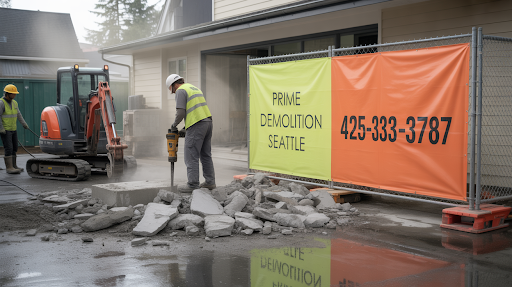
The methods for concrete removal vary depending on what you’re dealing with. For slabs and flat work like driveways and sidewalks, contractors typically use jackhammers or concrete breakers mounted on small excavators. These tools break the concrete into manageable pieces that can be loaded and hauled away.
For larger structural concrete like building foundations or retaining walls, excavators with hydraulic breakers do the heavy lifting. These machines can punch through reinforced concrete, break apart thick foundations, and reduce massive structures to rubble.
Sometimes the situation calls for concrete sawing instead of breaking. If you need to remove a section of concrete floor while leaving the rest intact, or if you’re cutting through a foundation wall, specialized concrete saws make clean, precise cuts. This method is common in selective demolition projects where you’re modifying existing structures rather than tearing everything down.
One aspect of concrete removal that surprises people is how heavy concrete actually is. A cubic yard of concrete weighs over two tons. When you’re removing a large foundation or breaking up a substantial parking area, you’re dealing with dozens or even hundreds of tons of material. This requires heavy-duty equipment for breaking, loading, and hauling, plus proper disposal at facilities equipped to handle it.
The Pacific Northwest has its own challenges when it comes to concrete demolition. Many older buildings here have foundations that extend deep into the ground because of our soil conditions and seismic requirements. Removing these foundations completely can be more complex than in other regions. Groundwater is another issue. When you’re breaking up foundations below grade, you often encounter water seepage that has to be managed during the removal process.
Recycling is a big consideration too. Washington has strong environmental standards, and concrete is one of the most recyclable demolition materials. Responsible contractors crush old concrete and reuse it as aggregate for new construction or road base. This reduces landfill waste and often lowers disposal costs compared to dumping everything.
Prime Demolition handles concrete removal projects of all sizes throughout the region. They have the heavy equipment necessary for breaking and removing substantial concrete structures, and they work with recycling facilities to ensure materials are disposed of responsibly rather than simply dumped in landfills.
Choosing the Right Method for Your Project
So how do you figure out which demolition method makes sense for your specific situation? It comes down to a few key questions.
First, what are you trying to accomplish? If you’re tearing down an entire building to clear a lot, mechanical demolition is almost always the answer. If you’re renovating and need to preserve certain parts of a structure, selective demolition or interior gutting becomes necessary. If you’re dealing specifically with concrete foundations, slabs, or hardscaping, you need a contractor with concrete removal expertise.
Second, what are the site conditions? Tight urban lots with limited access might require smaller equipment and more careful planning. Buildings adjacent to occupied structures need methods that minimize vibration and dust. Properties in historic districts often have restrictions that influence which demolition approaches are allowed.
Third, what’s your timeline and budget? Mechanical demolition is generally faster and less expensive than selective methods because it’s more straightforward. Interior gutting and selective demolition take longer because they require more precision, but they allow you to keep parts of the building you want to preserve.
The best approach is to talk with an experienced demolition contractor who can assess your specific situation. They’ll visit your property, understand your goals, identify any complications, and recommend the method that makes the most sense.
Prime Demolition offers free consultations for property owners throughout the Seattle and Tacoma area. Their team has experience with all these demolition methods and can guide you toward the approach that fits your project. Whether you’re dealing with a straightforward teardown, a complex selective demolition, or anything in between, starting with expert advice ensures you choose the method that delivers the results you need efficiently and safely.
Demolition might seem straightforward from the outside, but doing it right requires knowledge, experience, and the right equipment for the job. Understanding your options puts you in a better position to make informed decisions and move your project forward with confidence.