
In the damp, shaded coves where the Blue Ridge Mountains abruptly crash into the Piedmont of South Carolina, there lives a ghost. It is a small, unassuming plant with glossy, serrated leaves and a delicate white flower that looks like a fringed bell. To the casual observer walking through the woods in mid-March, it is just another patch of ground cover.
But to the scientific community, this plant—Shortia galacifolia, commonly known as the Oconee Bell—is the Holy Grail of North American botany.
Its story is one of the great detective sagas of natural history. It involves a French explorer, a 100-year disappearance, and a frantic search that captivated the greatest minds of 19th-century science. The existence of this flower is a testament to the unique, almost prehistoric ecology of the Jocassee Gorges, a place that acts as a biological ark for species that have no business surviving in the modern South.
The Discovery and the Disappearance
The mystery began in 1788. André Michaux, a royal botanist sent by King Louis XVI of France, was trekking through the rugged wilderness of the Carolinas. His mission was to find trees that could replenish the depleted forests of France.
Somewhere in the “high mountains of Carolina,” Michaux collected a specimen of an unknown plant. He pressed it, labeled it “High Mountains,” and sent it back to Paris.
Michaux never mentioned exactly where he found it.
Decades passed. In 1839, the legendary American botanist Asa Gray was rummaging through the herbarium in Paris when he found Michaux’s specimen. He knew instantly it was a new genus. He named it Shortia after his friend Charles Short, a Kentucky botanist.
Gray became obsessed with finding the living plant. He launched expedition after expedition into the Appalachians. He searched the peaks of Mount Mitchell and the valleys of the Smokies. He enlisted colleagues to scour the woods. For nearly 50 years, the most famous botanist in America hunted for a plant that seemed to have vanished from the face of the earth. It became known as “The Lost Plant.”
Gray famously lamented that he might die without ever seeing Shortia in bloom.
The Rediscovery
Then, in 1877, a teenage boy named George Hyams found a patch of the plant on the banks of the Catawba River, miles away from where Michaux had likely been. He sent it to Gray, who was ecstatic.
But the true heart of the Shortia population—the place where Michaux had likely stumbled upon it—wasn’t found until later, deep in the remote, rugged gorges of the Horsepasture and Whitewater rivers.
It turned out that Gray had been looking too high. He had been searching the peaks. Shortia is a creature of the creek banks. It demands a very specific, paradoxical environment: it needs the high rainfall of the mountains, but the humid, sheltered warmth of the valleys.
The Climate Paradox
Why was it so hard to find? And why is it found almost nowhere else on the planet?
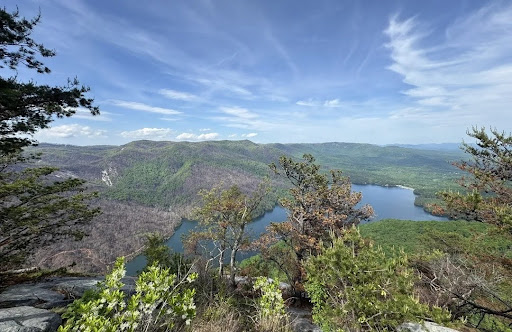
The answer lies in the geography of the Blue Ridge Escarpment. This is the “Blue Wall,” where the elevation drops 2,000 feet in a matter of miles. This vertical wall acts as a moisture trap. Warm, wet air from the Gulf of Mexico hits the wall, is forced upward, cools, and dumps massive amounts of rain.
This region receives over 75 to 80 inches of rain a year. It is technically a temperate rainforest.
This constant moisture, combined with the shade of the deep gorges, creates a microclimate that mimics the conditions of the ancient past. Biologists believe that Shortia is a “relict” species—a survivor from the Tertiary period. Before the last Ice Age, plants like this were widespread. As the glaciers advanced and retreated, most of these species were wiped out or forced to migrate.
But here, in these sheltered, wet coves, the climate remained stable. The Jocassee Gorges served as a refuge, a time capsule where “The Lost Plant” could wait out the millennia while the rest of the world changed around it.
Walking Through History
For the modern hiker, this adds a profound layer of meaning to a spring trek. When you walk the trails along the Whitewater River or the Toxaway, you aren’t just looking at pretty flowers. You are looking at survivors.
The Oconee Bell blooms early, usually mid-March to early April. It is a sign that the gorge is waking up. The plant is incredibly fussy. It essentially refuses to be transplanted. If you dig it up and move it to a garden in Atlanta or Charlotte, it will likely die. It needs the specific fungal relationships in the soil and the precise humidity of the gorge air.
This fragility makes the hiking experience feel like visiting a museum. You are walking through a gallery of living fossils.
The Threat and the Protection
The story of the Oconee Bell also has a tragic chapter. When Lake Keowee and Lake Jocassee were flooded in the 1970s, it is estimated that a significant percentage of the world’s Shortia population was drowned forever. The plants Michaux might have stepped on are likely 300 feet underwater.
This loss makes the remaining populations even more sacred. The trails that wind through Devil’s Fork State Park and the surrounding Gorges Management Area are the last line of defense for this species.
Conservationists and park rangers are protective of the exact locations of the densest patches to prevent poaching. But the plant is not invisible. If you know what to look for—the shiny, leathery leaves with jagged edges, hugging the ground near the stream banks—you can spot them.
Conclusion
The allure of the Jocassee Gorges is usually attributed to the waterfalls—the thundering power of water over rock. But the quieter miracle is in the leaf litter.
The fact that the greatest botanical mystery of the 19th century was solved here is no accident. This landscape is a fortress of biodiversity. It protects things. It hides things.When you lace up your boots to explore the Hiking Trails Near Lake Jocassee, you are entering the room where nature keeps her rarest secrets. You don’t need to be an 18th-century French explorer to appreciate it, but it helps to walk with the same sense of wonder. You are walking on ground that refused to let a species die, a damp, green sanctuary where the lost was finally found.