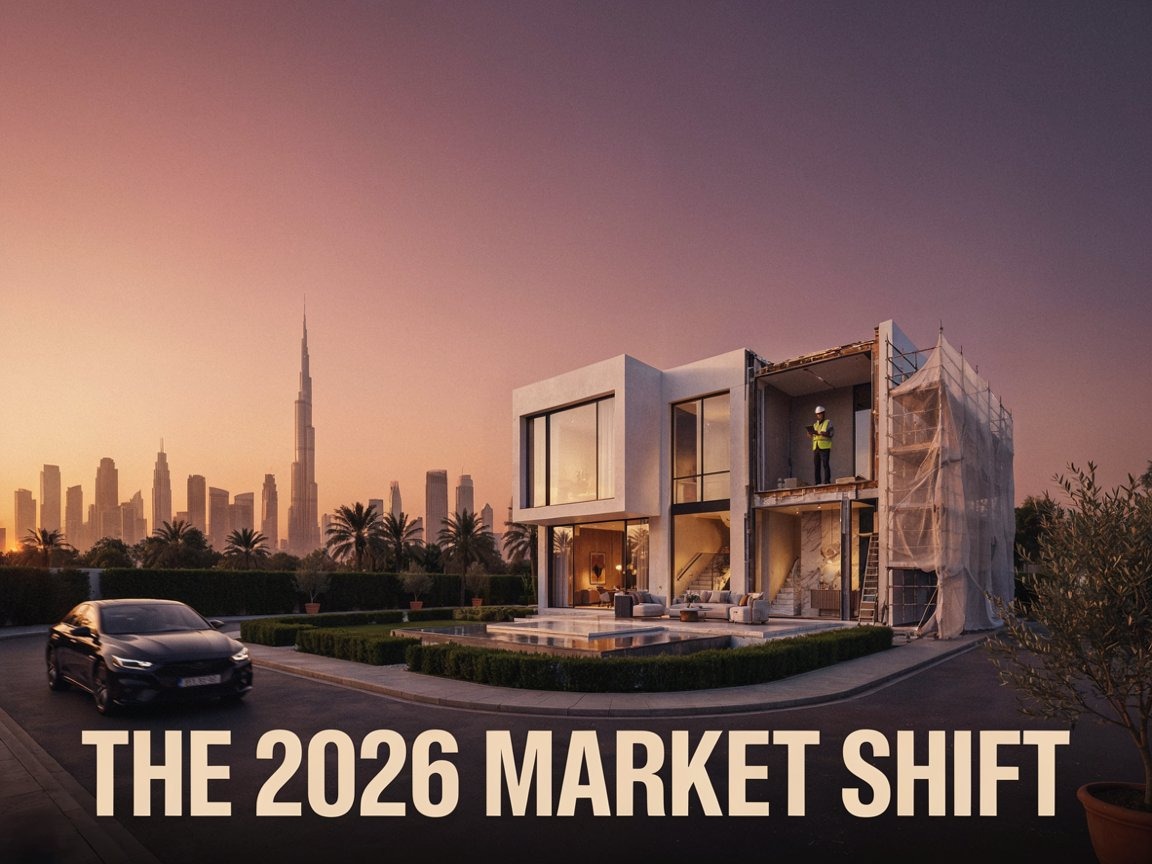
Something is happening across Dubai’s established villa communities that anyone watching the property market cannot ignore. Renovation enquiries are up. Contractors are booked weeks ahead. And the villas getting the most attention are not the newest ones — they are the 15 to 20 year old properties in communities like Arabian Ranches, The Meadows, Jumeirah, and Emirates Hills that have been quietly sitting on dated finishes for the better part of a decade.
This is not a coincidence. It is the result of several market forces converging at the same time, and understanding them helps explain why 2026 is shaping up to be one of the most active years for residential renovation Dubai has seen.
The Properties Are Ready For It
The first and most straightforward reason is age. A large proportion of Dubai’s established villa stock was built between 2002 and 2010. That puts the oldest of these properties at over 20 years old — which is exactly the window when kitchens feel dated, bathroom finishes look tired, and the MEP systems behind the walls start demanding attention whether the owner is ready or not.
In a city that builds new developments constantly, it is easy to forget that the first wave of master-planned communities is now genuinely old by UAE standards. The villas in Arabian Ranches 1, built from around 2004, are approaching the kind of age where a renovation is not optional if you want the property to hold its market position. The same is true across Al Reem, Saheel, Palmera, and Alvorada — sub-communities where the original Spanish Mediterranean character remains intact on the outside but the interiors are well overdue for a rethink.
This is the natural lifecycle of residential property everywhere in the world. Dubai has simply reached that point faster than most markets because of how quickly the city built at scale in the early 2000s.
The Property Market Is Rewarding Renovation
The second driver is financial, and it is a compelling one. Dubai’s villa market has performed exceptionally well over the past three years, with transaction volumes and sale prices in established communities reaching levels that make renovation a straightforwardly sensible investment.
A well-renovated villa in an established community commands a measurable premium over an unrenovated comparable unit on the same street. In communities like Arabian Ranches, that premium can reach AED 200,000 to 400,000 depending on the scope of the renovation and the finish level achieved. For owners who bought in the early 2000s and have seen substantial capital appreciation, spending AED 350,000 to 600,000 on a full mid-range renovation to unlock an extra AED 300,000 in sale value — while also living in a far more comfortable home in the meantime — is a calculation that makes sense on paper and in practice.
Rental yield tells a similar story. Renovated villas in sought-after communities achieve meaningfully higher annual rents than unrenovated properties in the same area. With Dubai continuing to attract high income expats across finance, technology, and professional services, demand for well-finished rental villas in communities like Jumeirah, Al Barsha, and The Meadows remains strong.
For anyone trying to understand the real numbers behind a renovation investment, a detailed breakdown of villa renovation cost in Dubai by tier and by room is genuinely useful before committing to any scope of work.
The Approval Process Has Become More Familiar
One of the reasons villa owners in Emaar communities historically delayed renovation was the approval process. The requirement to obtain an Emaar NOC before any contractor could begin work felt unfamiliar, bureaucratic, and slow. Many owners simply avoided it.
What has changed is that a growing number of experienced renovation contractors now handle the full Emaar NOC submission as a standard part of their service, removing the burden from the homeowner entirely. The process — submitting drawings through the Emaar One portal, coordinating with Dubai Municipality for structural permits, and managing DEWA where pool or electrical load is changing — is one that specialist contractors navigate regularly and efficiently.
This shift matters because it removes one of the primary psychological barriers that kept renovation projects on the to-do list for years. When the homeowner no longer has to deal with the approval process personally, the project becomes far less daunting to start. For owners specifically in Emaar-managed communities, understanding what villa renovation in Arabian Ranches actually involves — from Emaar NOC through to handover — removes most of the uncertainty that caused delays in the first place.
What Owners Are Actually Changing
The renovation briefs coming through in 2026 are notably more ambitious than the cosmetic refreshes that were common five years ago. Owners are not just repainting and replacing flooring. They are making structural changes that reflect how family life has evolved.
The single most requested change in AR1 villas is the open-plan kitchen conversion. The wall between the kitchen and the family room, standard in Emaar’s early builds, no longer fits how most families cook, eat, and spend time together. Removing it, and building a proper kitchen around an island with integrated appliances and stone worktops, transforms the ground floor completely.
Master bathroom upgrades follow close behind. Walk-in rainfall showers, freestanding baths, large-format marble or porcelain, and properly designed lighting are now the baseline expectation for any villa competing at the upper end of the rental or resale market. The bathrooms that came with early 2000s builds simply do not meet that standard anymore.
Outdoor spaces are the third area of significant investment. Many AR1 villa plots sit on 400 to 800 square metres of rear garden that has never been properly developed. A custom pool, a shaded pergola and outdoor dining area, and landscaping that actually uses the space changes the entire proposition of the property.
For UAE national and GCC owners, majlis renovation is consistently the first item on the brief — a space treated not as a room but as the centrepiece of the home and the primary expression of the family’s identity.
The Contractors Who Can Deliver Are Getting Busier
There is a practical consequence to all of this activity. The contractors who genuinely understand the full scope of a villa renovation — design, structural works, MEP, joinery, approvals, and handover managed under one contract — are in high demand. The gap between a contractor who handles surfaces and one who manages a full project including government submissions is significant, and homeowners who have been through a renovation once know exactly which type they want next time.
Companies like Favoritehome, operating across Emaar and non-Emaar communities throughout Dubai, have seen this demand directly. The enquiries coming in are for complete projects, not just cosmetic refreshes, and the owners asking are doing serious research before they commit. They want to see relevant experience, understand realistic timelines, and have a clear cost framework before any site visit takes place.
The Window Is Now
Dubai’s property market does not stay still. The owners who renovate their villas now, while demand for quality residential property in established communities is strong, will benefit both from living in a better home and from the market’s continued appetite for well-finished properties in proven locations.
The combination of aging villa stock that genuinely needs attention, a property market that rewards investment in quality, and a contractor landscape that has matured enough to handle the full project scope — approval to handover — makes 2026 a logical moment to act on renovation plans that may have been sitting on hold for years.
If you have been thinking about it, the question is less whether to renovate and more what the right scope and budget looks like for your specific property.