
As networks continue to evolve toward higher bandwidth, many organizations assume that fiber optics are the default path forward. While fiber undoubtedly offers advantages in long-distance and high-density environments, it is not always the most practical or cost-effective solution. In fact, for a large number of deployments, copper-based connectivity remains highly relevant. When evaluating 10G SFP+ modules, the real question is not whether fiber is better, but whether it is necessary for your specific use case.
In real-world scenarios, network design is often constrained by existing infrastructure, budget limitations, and deployment complexity. Many enterprise environments are already equipped with structured cabling systems based on Cat6a or Cat7 Ethernet cables. Replacing this with fiber can be both disruptive and expensive. This is where 10G SFP+ modules that support copper connectivity, such as 10GBASE-T, provide a compelling alternative by enabling 10G speeds over familiar RJ45 interfaces.
At the same time, the push toward higher efficiency and flexibility has made modular networking more attractive. Rather than committing entirely to fiber, organizations can selectively deploy 10G SFP+ modules based on actual needs. This hybrid approach allows networks to balance performance, cost, and ease of deployment, making copper modules an important part of modern network strategies.
Understanding 10GBASE-T SFP+: Ethernet Over Copper at 10G
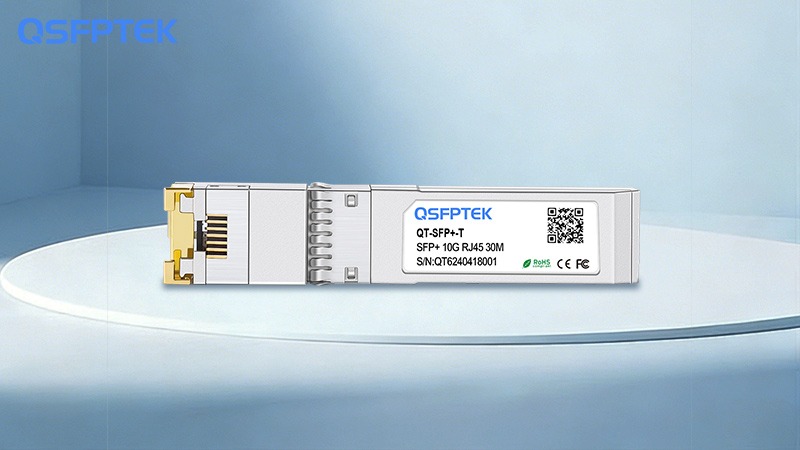
The 10GBASE-T SFP+ copper module is designed to deliver 10 Gigabit Ethernet over standard twisted-pair copper cabling. Using an RJ45 interface, it supports transmission distances of up to 30 meters over Cat6a or Cat7 cables, making it ideal for short-range, high-speed connections within racks or between nearby equipment.
Unlike direct attach cables (DAC), which are fixed-length and less flexible, 10GBASE-T modules allow the use of structured cabling systems. This means network operators can leverage existing Ethernet infrastructure without the need for specialized optical fiber or new cable installations. The result is a more adaptable and scalable solution, particularly in environments where frequent reconfiguration is required.
Another key advantage lies in compatibility. 10GBASE-T SFP+ modules often support auto-negotiation, enabling them to operate at multiple speeds such as 1G, 2.5G, 5G, and 10G. This backward compatibility simplifies integration with legacy equipment and ensures a smoother upgrade path for networks transitioning to higher speeds.
When Fiber Is Not Necessary
Despite the widespread adoption of fiber in modern networks, there are many scenarios where copper remains the more practical choice. One of the most common is short-distance connectivity within data centers or enterprise wiring closets. When link distances fall well within the 30-meter range, the performance benefits of fiber become less significant compared to its higher cost and complexity.
In such cases, 10GBASE-T SFP+ modules provide a straightforward solution. They eliminate the need for additional optical components, such as transceivers and fiber patch cords, while still delivering reliable 10G performance. For organizations looking to minimize upfront investment, this can result in substantial cost savings.
Another consideration is deployment simplicity. Copper cables are generally easier to install and manage than fiber, requiring less specialized handling and equipment. For IT teams without extensive experience in fiber optics, this can reduce both installation time and the risk of errors.
Real-World Use Cases for 10GBASE-T SFP+
In enterprise networks, 10GBASE-T SFP+ modules are often used to connect servers, switches, and storage systems within the same rack or across adjacent racks. Their ability to integrate seamlessly with existing RJ45-based infrastructure makes them particularly attractive for organizations upgrading from 1G to 10G Ethernet.
Small and medium-sized data centers also benefit from copper-based 10G connectivity. In these environments, the distances between devices are typically short, and the flexibility of using standard Ethernet cables outweighs the advantages of fiber. By deploying 10GBASE-T modules, operators can achieve high-speed connectivity without overhauling their entire cabling system.
Additionally, test labs and development environments frequently rely on 10GBASE-T for its convenience and adaptability. The ability to quickly connect and disconnect devices using familiar Ethernet cables simplifies setup and experimentation, making copper modules a practical choice for dynamic and evolving setups.
When Fiber Still Makes More Sense
While copper modules offer clear advantages in certain scenarios, fiber remains the preferred option for longer distances and high-density deployments. When link lengths exceed 30 meters, or when low latency and power efficiency are critical, optical solutions such as SFP+ SR or LR modules become more suitable.
Fiber is also better suited for environments with high electromagnetic interference (EMI), where copper cables may be more susceptible to signal degradation. In large-scale data centers with dense cabling requirements, the thinner and lighter nature of fiber can simplify cable management and improve airflow.
Moreover, power consumption is an important factor. 10GBASE-T modules typically consume more power than their optical counterparts due to the complexity of signal processing required for copper transmission. In large deployments, this can impact overall energy efficiency and operational costs.
Key Factors to Consider Before Choosing 10GBASE-T
Selecting between copper and fiber requires a careful evaluation of several factors. Distance is the most obvious consideration, but it should be assessed in the context of actual deployment conditions rather than theoretical limits. Ensuring that cable quality meets Cat6a or Cat7 standards is also essential for achieving reliable 10G performance.
Cost is another critical factor. While copper modules can reduce initial investment by leveraging existing infrastructure, their higher power consumption may offset some of these savings over time. Organizations should consider both capital and operational expenses when making a decision.
Flexibility and scalability should not be overlooked. If a network is expected to grow or change frequently, the adaptability of RJ45-based connections can be a significant advantage. On the other hand, if long-distance expansion is anticipated, investing in fiber from the outset may be more practical.
Finding the Right Balance for Your Network
The choice between fiber and copper is not a one-size-fits-all decision. Each technology has its strengths, and the optimal solution often involves a combination of both. 10GBASE-T SFP+ modules play a valuable role in this balance by providing a flexible, cost-effective option for short-range 10G connectivity.
Rather than defaulting to fiber for all high-speed links, network designers should take a needs-based approach. By analyzing distance, infrastructure, budget, and future requirements, it is possible to deploy the right technology in the right place. In many cases, copper modules can deliver the performance needed without the added complexity of fiber.
Ultimately, the question is not whether fiber is better, but whether it is necessary. And for many short-range applications, 10GBASE-T SFP+ modules offer a practical and efficient alternative that keeps networks both high-performing and easy to manage.